Know who deserves attention — and why now.
Your CRM can tell you who exists. It rarely tells you which accounts deserve attention today, what changed, or which evidence makes the timing credible.
A person decides whether to contact anyone and what to say.- 011,247 accountsExisting CRM↓
- 02Signals foundFit · timing · route↓
- 0382 relevantEvidence attached↓
- 0412 worth reviewingHuman shortlist↓
- 053 for todayDecision-ready
One mechanism. Four recognisable moments.
Select a business to see how the same underlying failure changes shape.
A prospect earns attention.
Hiring and expansion evidence makes the timing credible.
See the industry workflow- 01AccountIn list↓
- 02SignalTeam hiring↓
- 03ReviewToday
See what changes when the workflow holds together.
A list tells you who exists. Evidence tells you why now.
The moment loses context, time or ownership.
A person decides whether to contact anyone and what to say.Focused systems for the moments that matter.
Each pattern addresses one important handoff and keeps the final decision with your team.
Account intelligence
Bring fit, timing, evidence and a route in onto one account brief.
Buying-signal detection
Notice observable changes without treating every change as intent.
Follow-up ownership
Keep the next commercial step attached to a person and a time.
Qualification
Apply written criteria consistently while leaving judgement with the team.
Decision-ready account briefs
Reduce research into the few facts a person needs before acting.
See the workflow details
A bigger list did not produce more conversations
The instinct when pipeline is thin is to add names. Another data source, another export, another quarter of list building — and the list grows from four hundred to a thousand while the hours available to think about any single account stay exactly where they were. What changes is not coverage but dilution: the same selling time now has to be spread across more rows, so the research per account gets shorter, the messages get more generic, and the accounts that were worth a call this quarter are somewhere in the middle of a list sorted by nothing in particular. The team is not underperforming. It is being asked to make a thousand judgement calls with the time for twenty.
The list is sorted by something that is not a reason
Open most pipelines and the order on screen comes from date added, alphabetical order, or a score generated somewhere upstream. A score is not a reason. It is a number with the argument stripped out of it, and a rep cannot interrogate it — they cannot see which two facts produced it, whether either is still true, or what would change it. So the sensible response is to distrust it and fall back on memory, which means the top of the working list becomes whichever accounts somebody happened to open recently. The problem is not that people are choosing badly. It is that they are choosing with nothing to choose on, and a choice made that way cannot be reviewed, handed over, or improved by the next quarter.
The reason to call now is real, and it lives outside the system that holds the account
The things that make an account worth a conversation this month are rarely inside the CRM. A company posts two roles for the exact work you sell. A new commercial lead arrives and the person who blocked you last year moves on. A contract with an incumbent has a public renewal date. A regulation lands that changes what a whole sector has to do. These are observable, dated and often public — and they sit in job boards, filings, announcements and trade press, which are not places a rep can sweep across a thousand accounts by hand. So the account stays at whatever position the list ordering gave it, and the window is noticed later, if at all, usually because a competitor got there first.
The research was done. Then it evaporated between two people.
Somebody usually does look properly. A junior spends forty minutes on an account, reads the announcement, works out who owns the decision, notices the timing — and then compresses all of it into one line in a note field, because that is the only place the record allows. A week later a different person makes the call, sees “looks like a fit, worth a call”, and rebuilds the picture from memory or, more often, does not rebuild it at all. The conversation opens weak, the prospect answers a question the caller should already have known the answer to, and the forty minutes are spent again by somebody else next month. The research is not missing. It is unattached — separated from the account it belongs to, and from the person who will use it.
Sending more, to more people, makes the next quarter harder
When the list is long and the reasons are thin, the tempting move is volume: one message, a thousand accounts, and a hope that the arithmetic carries it. What that spends is not budget, it is the market’s willingness to hear from you again. A buyer who receives a message that plainly was not written about them learns something durable about your company, and the person who has to call that account next quarter — with a real reason, at a real moment — inherits the cost. This is why we do not build systems that conduct outreach on their own. A system that can identify a good moment and also act on it without a person is a system that can be wrong at scale, in your name, to the exact accounts you most wanted to keep.
System support
- Watching permitted sources for changes against the accounts you already hold
- Matching those signals to accounts, and to one record per company rather than three
- Checking each account against the fit, territory and exclusion rules you wrote down
- Assembling the evidence for why an account looks ready, with a link to each source
- Proposing who appears to own the decision and who else would need to approve it
- Pulling past conversations, closed-lost history and open opportunities into one view
- Reducing a long list to a short one and showing the reasoning behind each place on it
- Drafting an approach for a named person to read, change or discard
- Keeping a record of what was shortlisted, what was rejected, and on what grounds
Your team decides
- Deciding which accounts are worth pursuing, and which the shortlist got wrong
- Judging whether a signal actually means what it appears to mean
- Choosing who is approached, in what order, and through which channel
- Approving every message before it reaches a prospect
- Setting positioning, price and what the business is willing to promise
- Deciding when an account should be left alone this quarter
- Holding the conversation once somebody replies
- Owning the relationship, and the commitments made inside it
See what exists today.
Explore related products, case studies, internal builds and clearly marked system concepts.
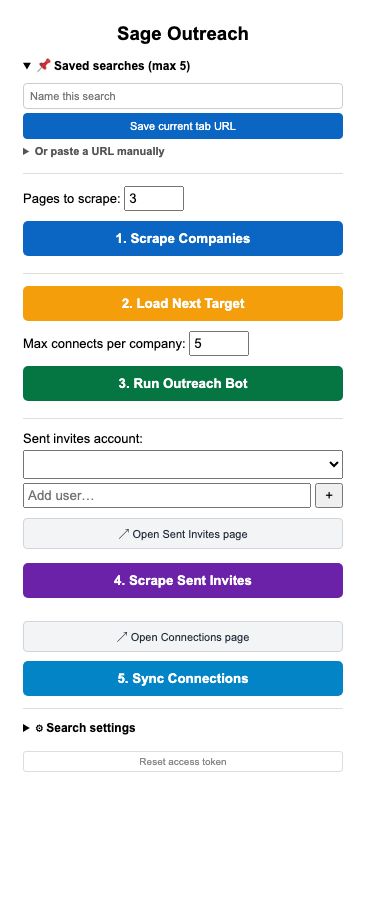
Sage Outreach
A focused B2B outreach session requires company collection, decision-maker discovery, controlled actions and acceptance tracking across repeated browser steps.
See What We’ve BuiltAccount Intelligence Engine
A thousand accounts sit in a list, and no one can say which few deserve attention this week or why.
Review a WorkflowHave a workflow worth making dependable?
Show us what happens today. We’ll help you decide whether a focused system is worth building.